


A compliance report can be well written and still rest on weak evidence.
It may describe a control.
It may record an approval.
It may include screenshots, spreadsheets, and attestations.
Those artifacts can be useful.
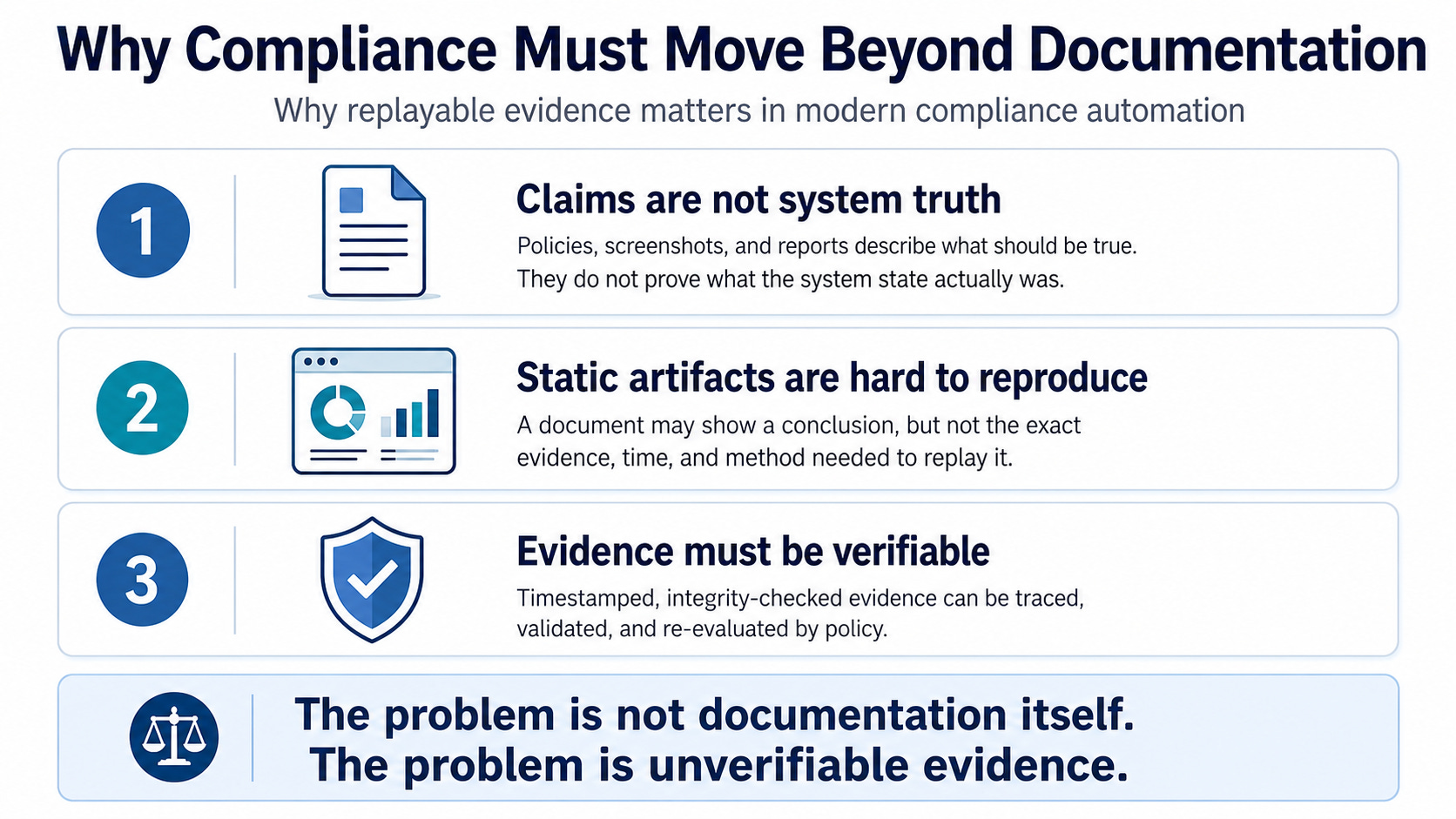
But they do not automatically establish what a system was doing at a particular time.
That is the starting point for CodeYourCompliance:
Technical compliance conclusions should be supported by evidence that can be inspected, evaluated, and replayed.
The title is deliberately sharp.
It does not mean documentation has no value.
Documentation can establish requirements, ownership, design intent, review activity, and management decisions.
The boundary is narrower:
Documentation about a technical control is not the same as evidence of the observed technical state.
The audit problem starts before the report
Suppose a report states:
The production certificate was valid and complied with the approved expiry policy.
The sentence may be correct.
The reviewer still needs to know:
which endpoint was observed;
when the observation occurred;
how the certificate data was collected;
whether collection succeeded across the required scope;
whether the preserved object changed later;
which policy version evaluated it;
and whether the narrative refers to that same result.
Without those links, the report records a conclusion but not a reproducible decision path.
Reports persuade.
Evidence survives.
What replay means
Replay does not mean recreating the historical live system.
That may be impossible.
Replay means preserving enough context to evaluate the recorded evidence again.
A replayable package should allow a later reviewer to identify:
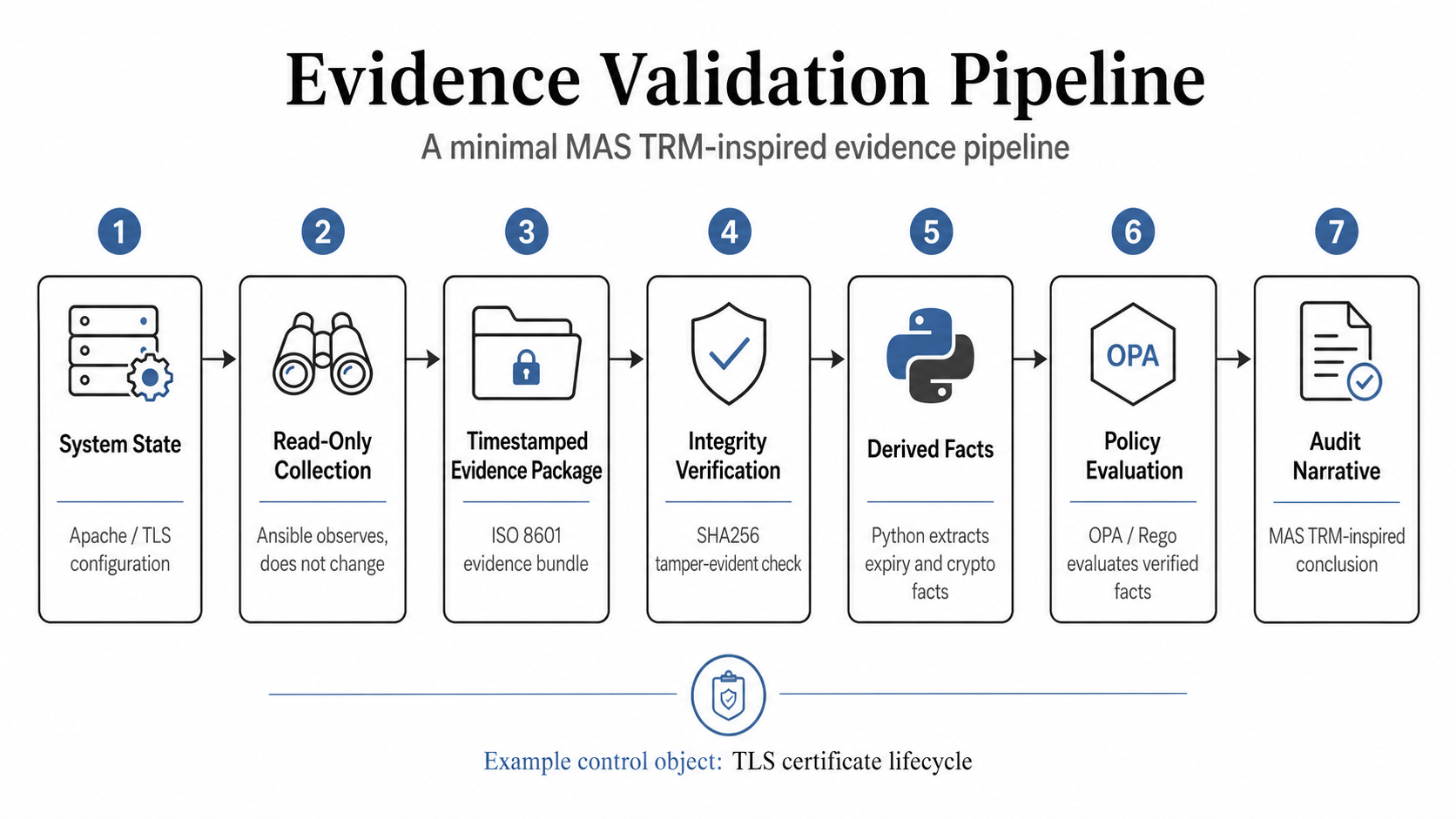
observed state→ collector and collection result→ timestamped evidence object→ integrity result→ normalized facts→ policy version and inputs→ policy result→ audit narrative
The same evidence and policy bundle should produce the same result.
A new observation may produce a different result because the system has changed.
That is not replay failure.
It is a different observation.
For the dedicated replay test, see Can Your Audit Evidence Survive Replay?.
A minimal evidence path
A narrow TLS certificate example is enough to expose the architecture.
An automated collector observes the certificate presented by a defined endpoint.
The output is packaged with:
target identity;
observation time;
collector identity and version;
collection status;
certificate facts;
and an integrity reference.
The evidence is then validated before policy evaluation.
OPA/Rego may be used for the policy step, but the tool is not the point.
The boundary is:
Policy evaluation should not silently convert unusable evidence into a control result.
If collection failed, the result is not automatically control_fail.
If the object does not match its trusted integrity reference, the result is not pass or fail.
It is an evidence problem.
If valid evidence shows that the certificate falls inside the organization’s prohibited expiry window, the result may be control_fail.
Those states must remain separate.
For the underlying evidence model, see Compliance Automation Starts at Evidence.
Integrity is not truth
A SHA256 digest can help detect whether a preserved object differs from the object that was originally sealed.
That claim depends on the expected digest being stored through a sufficiently independent and trusted process.
The digest does not prove:
that the collector observed the correct target;
that the collected scope was complete;
that the source was authoritative;
that the data was accurate;
or that the control operated continuously.
Integrity is one property of evidence.
It is not authenticity, completeness, or control effectiveness.
Observation is not remediation
The collector should not quietly correct the condition it is measuring.
If the certificate is near expiry, the original observation should survive.
Renewal is a separate action.
It needs its own approval, execution record, actor identity, and post-change verification.
If the collector changes the system, the evidence has already lost part of its value.
For that boundary, see Read-Only Collection as an Audit Boundary.
MAS TRM-inspired, not MAS-prescribed
MAS TRM does not prescribe this pipeline.
It does not require Ansible, Python, SHA256, OPA, or Rego.
The architecture is an engineering interpretation of broader expectations around technology risk management, control assurance, monitoring, evidence protection, and cryptographic lifecycle management.
The TLS example does not prove MAS TRM compliance.
It demonstrates how one technical claim can be connected to inspectable proof material.
The position
Compliance includes documentation.
It also includes governance, accountability, policy, review, and judgment.
But where a conclusion depends on technical system state, documentation alone is not enough.
The evidence path should preserve:
what was observed;
how it was collected;
whether the evidence was usable;
which rule evaluated it;
and how the conclusion was produced.
Checklist is coordination.
Evidence is proof material.
Policy evaluation is judgment.
Report is narrative.
Do not let the narrative replace the evidence.
Companion Repository
The public technical artifacts are maintained at:
codeyourcompliance/evidence-validation-pipeline
Substack explains the problem language.
GitHub stores the public technical artifacts.
Continue the Series
Origin
CodeYourCompliance
Website: https://www.codeyourcompliance.com/
GitHub: https://github.com/codeyourcompliance
Attribution is requested for forks, references, adaptations, and public discussion.
Scope Boundary
MAS TRM-inspired means engineering interpretation.
This material is not legal, regulatory, audit, certification, implementation, or compliance advice.