


A team completes its MAS TRM-aligned checklist.
Every row is marked complete.
The control owner is assigned.
Evidence links are attached.
A report is prepared.
Then a reviewer asks:
When was the TLS certificate state observed?
Nobody answers cleanly.
Which endpoint was inspected?
Who collected the evidence?
Was the required scope complete?
Did the collector change the target?
Has the evidence changed since collection?
Did the policy result evaluate the same evidence object?
The checklist still looks complete.
The evidence chain does not.
That is the failure mode.
A checklist can organize compliance work. It cannot by itself establish that a technical condition was true at a specific time.
MAS TRM is the context. It does not prescribe this checklist, evidence schema, collector, or policy pipeline.
MAS TRM-inspired means engineering interpretation.
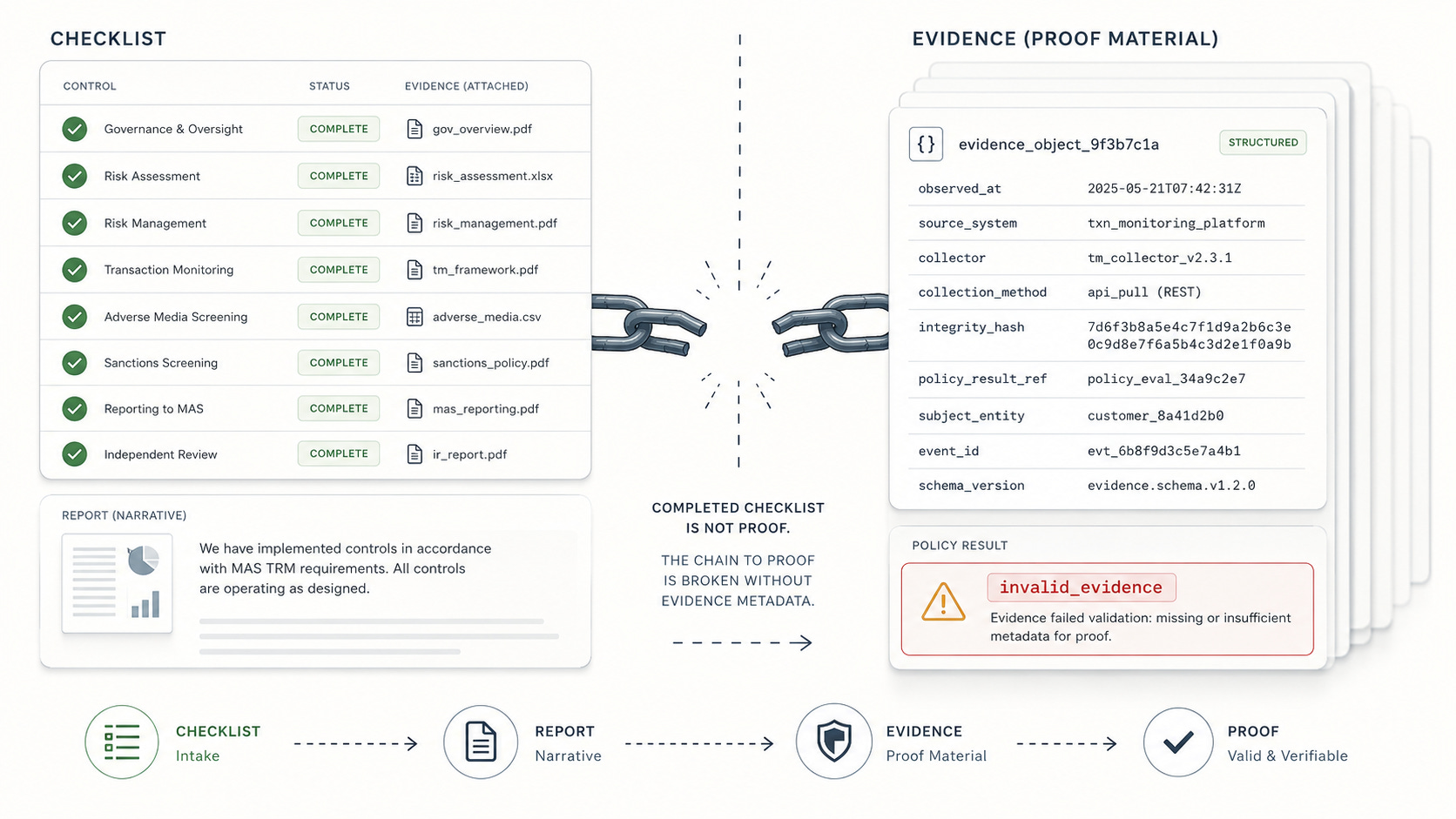
A checklist is a coordination object
A checklist is useful.
It can record:
the control topic;
the assigned owner;
the review status;
the requested artifact;
and the completion date.
A signed checklist may also show that an attestation, review, or approval occurred.
That is evidence of a process action.
It is not the same as evidence of the underlying system state.
A row marked “TLS certificate valid” does not establish:
which certificate was observed;
which endpoint presented it;
when it was observed;
whether all in-scope endpoints were checked;
or whether the evidence came from an authoritative source.
The checklist records the workflow around the claim.
The evidence object supports the claim itself.
The green status is a narrative state.
It is not automatically a technical state.
The control may operate on some systems but not the full scope.
It may have operated at the time of review but failed later.
It may have been remediated before the original failure was preserved.
A checklist cannot resolve those questions without linked evidence requirements.
Each row needs an evidence contract
The useful extension to a checklist is not another comments column.
It is an evidence contract.
For “TLS certificate satisfies the approved expiry policy,” the evidence requirement might include:
target_id: production-load-balancer
evidence_type: tls_certificate_observation
observed_at: 2026-05-25T10:31:00Z
collector_id: tls-cert-collector
collector_version: 0.1.0
collection_status: success
certificate_not_after: 2026-09-01T00:00:00Z
integrity_hash: sha256:...
policy_result_ref: policy-results/tls-cert-valid-2026-05-25.json
Each field answers a different challenge.
target_ididentifies what was inspected.
observed_atanchors the observation in time.
collector_ididentifies the process that produced the output.
collection_statusprevents failed collection from silently becoming a control result.
integrity_hashhelps detect mutation after sealing.
policy_result_reflinks the conclusion to the evidence actually evaluated.
The schema does not prove control effectiveness.
It makes the basis of the judgment inspectable.
For the upstream model, see Compliance Automation Starts at Evidence.
An attachment is not automatically evidence
A checklist may accept anything that can be uploaded.
A screenshot.
A PDF export.
An email confirmation.
A spreadsheet.
A meeting note.
These artifacts may support a review.
They do not automatically establish provenance, scope, freshness, integrity, or source authority.
A screenshot may show a screen without identifying the endpoint or capture time.
A spreadsheet may list users without showing whether it came from the authoritative identity system.
A PDF may record approval without proving that the approved data matches the data used in policy evaluation.
The problem is not the file format.
The problem is the unsupported claim.
Data alone is not evidence.
Provenance makes it usable.
Observation and remediation need separate records
A team observes that logging is disabled.
Someone enables logging.
The row becomes green.
The report says the issue is resolved.
But several events occurred:
The original state was observed.
A remediation action was approved.
The configuration was changed.
The post-change state was checked.
The checklist status was updated.
These are not one evidence object.
The original observation supports the finding.
The change record supports the remediation action.
The later observation supports post-change verification.
The checklist coordinates the sequence.
If the original evidence is replaced by a clean post-remediation screenshot, the audit trail loses the failure it claims to have corrected.
For that boundary, see Read-Only Collection as an Audit Boundary.
Evidence states must remain separate
A binary checklist encourages pass or fail.
The evidence pipeline needs more precise states.
control_failmeans valid evidence was collected, but the observed state did not satisfy the policy.
invalid_evidencemeans evidence was supplied, but its integrity, provenance, identity, or linkage cannot be relied upon.
insufficient_evidencemeans required evidence is missing, incomplete, stale, or outside the intended scope.
These states are not interchangeable.
Missing evidence does not prove control failure.
A failed hash does not prove non-compliance.
A green checklist row does not repair either problem.
The useful chain
Control expectation
→ Checklist item
→ Evidence requirement
→ Evidence object
→ Validation result
→ Policy result
→ Audit narrative
The checklist coordinates the work.
The evidence object preserves the observation.
Validation determines whether the evidence is usable.
Policy evaluation tests a defined condition.
The report explains the result.
For the later verification test, see Can Your Audit Evidence Survive Replay?.
The position
A checklist can show that work was assigned, reviewed, attested, or closed.
It cannot by itself establish the underlying technical state.
It cannot prove complete scope.
It cannot prove continuous operation.
It cannot prove that the attached artifact was the object used for policy evaluation.
Checklist is coordination.
Evidence is proof material.
Policy evaluation is judgment.
Report is narrative.
Do not confuse them.
Related Reading
Origin
CodeYourCompliance
Website: https://www.codeyourcompliance.com/
GitHub: https://github.com/codeyourcompliance
Attribution is requested for forks, references, adaptations, and public discussion of this material.
Scope Boundary
MAS TRM-inspired means engineering interpretation.
This material is not legal, regulatory, audit, certification, implementation, or compliance advice.