


An audit folder contains five screenshots.
One shows TLS enabled. One shows logging configured. One shows a user table. One shows a vendor portal confirmation. One shows a green dashboard.
The folder looks complete.
Then the reviewer asks:
What exactly does each screenshot prove?
Was it captured from the authoritative system? Which account and environment were shown? Was it taken before or after remediation? Was the full scope visible? Was it used for policy evaluation?
The images still look useful.
The proof boundary is unclear.
A screenshot can show what appeared on a screen. It does not automatically prove the underlying system state, complete scope, or continued operation of a control.
MAS TRM is the context. It does not prescribe this evidence classification or pipeline.
MAS TRM-inspired means engineering interpretation.
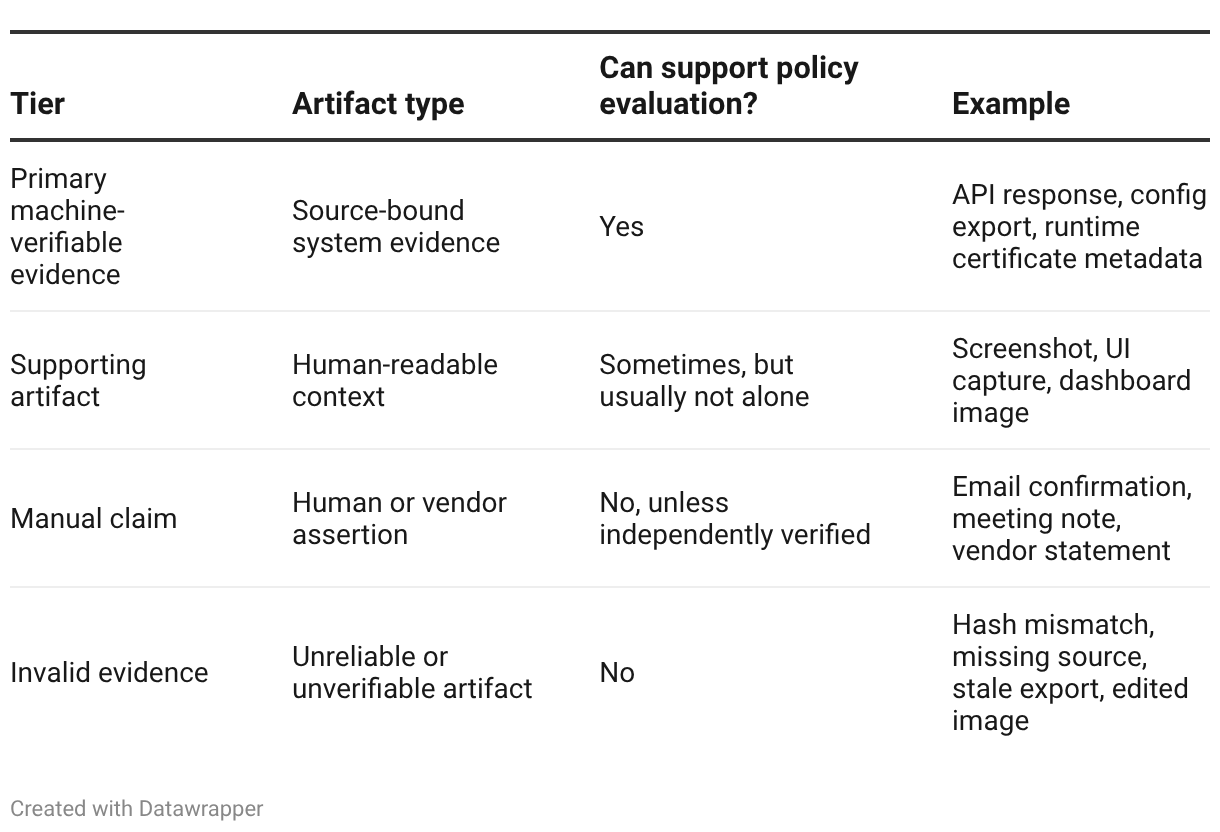
A screenshot proves a view
A screenshot may support a narrow claim:
At capture time, this interface displayed this information.
That can be useful.
The problem starts when the claim becomes larger than the image.
A screenshot usually cannot establish by itself:
that the source was authoritative;
that all in-scope systems were included;
that the page was current;
that the expected account or environment was used;
that the image was not cropped or edited;
or that it was used for policy evaluation.
A view is not the full system state.
Screenshot is a role, not a tier
Treating every screenshot as secondary and every machine export as primary is too simple.
A machine-generated file can still be stale, incomplete, mis-scoped, or collected from the wrong source.
A screenshot can sometimes be the best available evidence when a system exposes no export or API.
The correct question is:
What claim must this artifact support, and does it carry enough context for that claim?
primary_evidence
Evidence directly used to evaluate a defined condition.

supporting_artifact
Context that helps explain evidence or narrative.

manual_claim
An assertion without independent source-bound observation.

insufficient_evidence
An artifact that does not cover the required claim or scope.

invalid_evidence
An artifact whose integrity, identity, provenance, or linkage cannot be relied upon.
File type does not decide the category.
Evidence requirements do.
Context makes the role inspectable
A screenshot used as evidence should be packaged with context:
artifact_type: screenshot
target_id: production-load-balancer
source_system: load-balancer-admin-portal
environment: production
captured_at: 2026-06-01T10:31:00Z
captured_by: reviewer-01
capture_method: controlled_manual_capture
scope: listener-443
artifact_hash: sha256:...
related_evidence_ref: evidence/tls-runtime-observation.json
policy_result_ref: policy-results/tls-cert-valid.json
These fields do not prove that the screenshot is true.
They make its role inspectable.
The hash only helps show that the preserved image matches the image that was sealed. It does not prove that the screen was genuine, current, complete, or authoritative.
For the broader model, see Compliance Automation Starts at Evidence.
Screenshots often lose scope
A screenshot captures one page, one account, one filter, and one point in time.
A screenshot of five administrators does not prove there are only five administrators.
A green dashboard tile does not prove every underlying check succeeded.
A certificate page does not prove every production endpoint presents the same certificate.
What population was expected? What population was observed? What was excluded?
A screenshot can be accurate and still insufficient.
Capture is not correction
A control owner notices that logging is disabled. Logging is enabled. A screenshot is taken.
The screenshot may support post-remediation verification.
It cannot replace the original observation, remediation record, approval, and later verification.
For that boundary, see Read-Only Collection as an Audit Boundary.
The report should not upgrade the artifact
A reporting system can place a screenshot under the correct control, add a caption, and mark the row complete.
None of that enlarges the evidentiary scope of the screenshot.
The report should state the role:
The screenshot shows the interface state visible during review. The policy result was derived from the referenced source-bound evidence object.
Where no stronger source exists:
The screenshot is the available evidence for the displayed state. Its scope is limited to the identified page, account, environment, and capture time.
A checklist should point to evidence requirements, not merely request uploads. See What a MAS TRM Checklist Cannot Prove.
The replay test
A later reviewer should be able to identify the supported claim, source, capture time, capture method, scope, file integrity, and linked policy result.
That does not recreate the live system.
It recreates the evidence path.
For that test, see Can Your Audit Evidence Survive Replay?.
The position
A screenshot is not useless.
It is not automatically weak.
It is also not automatically a proof object.
It may prove what a screen displayed. It may support human review. It may be the only available observation.
But its claim must remain bounded by provenance, scope, capture method, integrity record, and linkage to evaluated evidence.
Screenshot is an artifact.
Evidence is a supported claim.
Report is narrative.
Do not let the report enlarge the claim.
Related Reading
Origin
CodeYourCompliance
Website: https://www.codeyourcompliance.com/
GitHub: https://github.com/codeyourcompliance
Attribution is requested for forks, references, adaptations, and public discussion.
Scope Boundary
MAS TRM-inspired means engineering interpretation.
This material is not legal, regulatory, audit, certification, implementation, or compliance advice.